Introduction
Space is no longer an empty void reserved for distant exploration. In the 21st century, it is rapidly transforming into a new arena for economic growth, innovation, and international collaboration. The backbone of this emerging space economy is space infrastructure — the systems, technologies, and facilities that enable humanity to operate, live, and work beyond Earth.
From satellite constellations and orbital stations to lunar bases and interplanetary supply chains, space infrastructure development is redefining what it means to expand civilization beyond our planet. As governments, private companies, and global partnerships invest billions into this domain, the question is no longer if we will build in space — but how we can do it sustainably and efficiently.
What Is Space Infrastructure?
Space infrastructure refers to the physical and digital framework that supports activities in and beyond Earth’s orbit. Just as roads, airports, and communication networks form the foundation of terrestrial economies, space infrastructure provides the essential tools and platforms for a thriving space economy.
It encompasses:
- Launch systems and spaceports
- Satellites and communication networks
- Space stations and habitats
- Navigation and tracking systems
- Lunar and Martian bases
- Energy and resource extraction systems
- On-orbit manufacturing and servicing facilities
Together, these interconnected systems form the infrastructure of a multi-planetary civilization — enabling everything from commercial enterprise to scientific exploration.
The Evolution of Space Infrastructure
1. The Early Era (1957–1990s)
The infrastructure of space began with the Cold War Space Race. The Soviet Union’s Sputnik 1 (1957) and the U.S. Apollo missions (1960s) laid the groundwork for space engineering, navigation, and launch technology.
The construction of the International Space Station (ISS), launched in 1998, marked the first permanent human outpost in space and one of the greatest collaborative infrastructure projects in human history.
2. The Commercial Era (2000–2020)
With the rise of private companies like SpaceX, Blue Origin, Rocket Lab, and Virgin Galactic, space infrastructure development shifted from government control to public–private partnerships.
Reusable rockets, miniaturized satellites, and global communication networks created a commercial ecosystem that now powers everything from navigation to climate monitoring.
3. The New Frontier (2020–Present)
Today, space infrastructure is expanding toward the Moon, Mars, and beyond. Projects such as NASA’s Artemis Program, China’s Tiangong Space Station, and SpaceX’s Starship development aim to create permanent facilities for transport, research, and resource utilization beyond Earth’s orbit.
Key Components of Space Infrastructure
Launch Infrastructure
Launch vehicles and spaceports form the foundation of space access. Traditional sites like Cape Canaveral (U.S.) and Baikonur (Kazakhstan) have been joined by new private and international facilities in New Zealand, India, and the UAE.
Reusable rocket systems — pioneered by SpaceX’s Falcon 9 and Blue Origin’s New Shepard — have revolutionized launch economics, making frequent and affordable access to orbit possible.
Future plans include offshore floating launch pads, designed to reduce environmental impact and support high-frequency missions.
Orbital Infrastructure
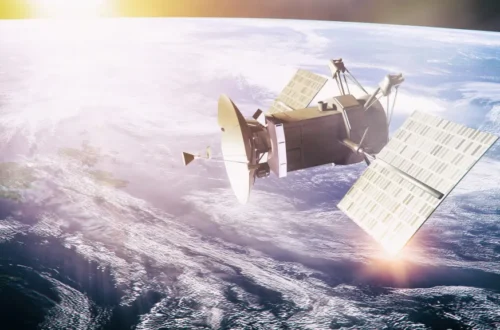
Once in orbit, satellites and space stations form the key operational layer of space infrastructure.
- Satellite Constellations: Networks like Starlink and OneWeb provide global internet coverage, connecting even the most remote regions on Earth.
- Space Stations: The ISS remains humanity’s primary laboratory in microgravity, but new private stations such as Axiom Space Station and Orbital Reef (by Blue Origin and Sierra Space) are under development to replace it by the 2030s.
- In-Orbit Refueling and Repair: Companies like Northrop Grumman and Astroscale are building systems to extend satellite lifespans through in-orbit servicing — a critical step toward a sustainable orbital economy.
Lunar Infrastructure
The Moon is the next major target for infrastructure expansion. It serves as both a testing ground for Mars missions and a potential economic hub.
Key developments include:
- Lunar Gateways: NASA and its partners are constructing the Lunar Gateway, an orbiting station to support Artemis missions and future lunar habitats.
- Surface Bases: Plans for permanent lunar bases include the use of in-situ resource utilization (ISRU) — using local materials like regolith to build habitats and extract oxygen and water.
- Mining and Energy: The Moon’s south pole contains abundant water ice and rare elements like helium-3, which could power future fusion reactors.
Lunar infrastructure is not only about exploration — it’s about creating a supply chain that supports long-term human presence in deep space.
. Energy and Power Systems
Reliable energy is vital for space operations. Solar power dominates current infrastructure, but new technologies are emerging:
- Space-Based Solar Power (SBSP): Satellites equipped with massive solar panels can beam energy to Earth or lunar colonies.
- Nuclear Energy: Compact nuclear reactors, such as NASA’s Kilopower project, promise consistent power for habitats on the Moon or Mars.
- Wireless Energy Transmission: Laser or microwave systems could transfer power across space infrastructure networks.
Manufacturing and Construction
Building infrastructure in space is far more efficient than transporting everything from Earth.
- 3D Printing and Additive Manufacturing: Companies like Made In Space and Redwire are developing 3D printers capable of using lunar regolith or recycled materials from old satellites.
- Modular Construction: New habitats and spacecraft are designed as modular systems, allowing for in-orbit assembly and expansion.
- Robotics: Autonomous robots will play a major role in constructing habitats, mining resources, and maintaining facilities in hazardous environments.
These technologies are the foundation of what many call the “Orbital Industrial Revolution.”
Economic and Strategic Importance
Space infrastructure development is not merely scientific — it’s economic and geopolitical.
Economic Growth
The space economy is projected to reach $1.5 trillion by 2040, with infrastructure projects forming the largest share. New industries — from satellite internet and resource mining to tourism — will depend on these systems.
National Security
Countries view space infrastructure as strategic assets. Communication, navigation, and defense systems rely on satellites that must be protected and maintained. Nations investing early in space infrastructure gain significant technological and military advantages.
International Cooperation
Major projects like the ISS and Artemis illustrate that global collaboration is essential. The future of space development will likely involve joint ventures that combine public funding, private innovation, and shared governance.
Challenges in Developing Space Infrastructure
Cost and Investment Risks
Building in space remains extremely expensive, with launch costs, material development, and mission logistics consuming billions.
Space Debris and Safety
The growing number of satellites increases the risk of collisions. Infrastructure must be designed with debris mitigation and collision avoidance in mind.
Regulatory Uncertainty
Space law — particularly regarding property rights and resource ownership — remains ambiguous. The Outer Space Treaty (1967) prohibits sovereignty claims, but it doesn’t clearly define commercial rights.
Sustainability Concerns
As space activities expand, environmental stewardship is vital — both in orbit and at launch sites. Reusability and waste management are crucial for long-term operations.
Technological Limitations
Radiation, microgravity, and extreme temperatures pose serious engineering challenges. Durable materials, autonomous systems, and self-repair technologies are still under development.
Future of Space Infrastructure
The next two decades will witness unprecedented growth in space infrastructure. Some key trends include:
- Permanent Lunar and Martian Bases: Self-sustaining habitats powered by renewable energy and local resources.
- Orbital Logistics Hubs: Refueling and cargo stations to support deep-space missions.
- Interplanetary Transport Systems: SpaceX’s Starship aims to make regular travel between Earth, Moon, and Mars feasible.
- Space-Based Industries: Manufacturing semiconductors, fiber optics, and pharmaceuticals in microgravity environments.
- AI and Robotics Integration: Fully autonomous systems managing construction and maintenance.
In the long term, space infrastructure will evolve into a multi-layered network connecting Earth, orbit, and interplanetary destinations — a true extension of human civilization.
Conclusion
Space infrastructure development is the cornerstone of the new space era. What once seemed like science fiction is rapidly becoming reality, powered by innovation, investment, and collaboration.
From launch systems and satellites to lunar bases and energy grids, this infrastructure is enabling a permanent human presence in space. Yet, with this progress comes the responsibility to build sustainably, equitably, and cooperatively.
As we construct the scaffolding of a spacefaring civilization, we are not merely expanding our reach — we are defining humanity’s future. The stars are no longer out of reach; they are the next chapter of our shared infrastructure.