Introduction
In today’s digital era, access to the internet has become as essential as access to electricity or clean water. Yet, billions of people around the world still live without reliable internet access, particularly in remote and rural regions. Traditional internet infrastructure — fiber-optic cables, cell towers, and broadband lines — often fails to reach these isolated areas because of high costs and challenging geography.
This is where satellite internet emerges as a revolutionary solution. By transmitting data directly from space, satellite-based networks can provide global connectivity — from the heart of major cities to the most distant villages. The dream of a connected planet is closer to reality than ever, thanks to advancements in satellite technology and the rise of private space companies.
What Is Satellite Internet?
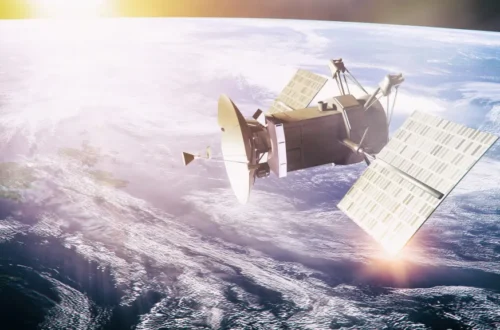
Satellite internet is a type of wireless communication system that connects users to the internet through satellites orbiting the Earth. Instead of relying on cables or towers, data is transmitted between a user’s ground dish (antenna) and satellites in space, which then relay the signal to a network operations center connected to the global internet.
How It Works:
- A user sends a request (for example, loading a website).
- The signal travels from the user’s dish to a satellite orbiting Earth.
- The satellite sends the data back to a ground station linked to the internet backbone.
- The requested information (like a webpage or video) is sent back to the user through the same path.
This process happens almost instantaneously — though traditionally, satellite internet has faced issues like high latency (delay) and limited bandwidth. However, modern satellite networks are overcoming these challenges with new generations of low Earth orbit (LEO) satellites.
Evolution of Satellite Internet
The concept of using satellites for communication dates back to the 1960s, when early systems like Telstar and Intelsat demonstrated the potential for transmitting signals globally. However, these early satellites operated in geostationary orbit (GEO) — about 35,786 kilometers (22,236 miles) above Earth.
While GEO satellites provided wide coverage, they suffered from high latency (roughly 600 milliseconds round-trip) and limited data capacity. This made them unsuitable for real-time applications like video calls or online gaming.
In the 21st century, technological innovation has led to a new generation of LEO satellite constellations — networks of hundreds or thousands of satellites orbiting at altitudes between 500 and 2,000 kilometers. These satellites can provide faster speeds, lower latency, and greater reliability.
Major Players in Satellite Internet
Several companies are leading the race to provide global broadband coverage from space.
SpaceX’s Starlink
Perhaps the most well-known player, Starlink is operated by SpaceX and currently has over 6,000 satellites in orbit (as of 2025). The network offers download speeds ranging from 50 Mbps to 250 Mbps and latency as low as 25–40 milliseconds — comparable to terrestrial broadband.
Starlink targets underserved regions, disaster zones, and mobile users such as ships, airplanes, and military units.
OneWebBacked by the UK government and Bharti Enterprises, OneWeb aims to create a global network of about 650 LEO satellites. Its focus is on providing connectivity to schools, rural communities, and enterprises across developing regions.
Amazon’s Project Kuiper
Amazon is entering the competition with Project Kuiper, planning to deploy over 3,200 satellites. Backed by Amazon’s logistics and cloud computing power (AWS), Kuiper aims to integrate space internet with Amazon’s digital ecosystem.📡 Telesat and Other Players
Canadian company Telesat Lightspeed, as well as Chinese and Indian initiatives, are also entering the field, ensuring that satellite internet will be a globally competitive industry.
Benefits of Satellite Internet
1. Global Coverage
Unlike fiber or cable networks that depend on ground infrastructure, satellites can cover the entire planet. Remote islands, deserts, mountains, and polar regions — all can be connected.
Rapid Deployment
In areas affected by disasters or war, traditional networks may be destroyed or unavailable. Satellite internet can be deployed within hours, making it invaluable for emergency communication and humanitarian aid.
Scalability and Mobility
Users don’t need fixed connections. Satellite internet is ideal for mobile users — ships, aircraft, military units, or scientific expeditions.
Bridging the Digital Divide
By bringing high-speed internet to remote areas, satellite networks can transform education, healthcare, and business opportunities for billions of people.
Challenges and Limitations
Despite its promise, satellite internet faces several obstacles:
Cost and Accessibility
Although launch and hardware costs are decreasing, user terminals (antennas) and subscription fees remain high for many households in developing countries. A Starlink terminal, for example, costs around $599, with monthly fees near $120.
Space Debris and Congestion
Thousands of satellites in orbit raise concerns about space debris, potential collisions, and the sustainability of Earth’s orbit. Companies must coordinate to avoid accidents and manage orbital traffic responsibly.
Interference and Weather IssuesHeavy rain, snow, or dense cloud cover can weaken satellite signals — a problem known as rain fade. Advances in frequency management and adaptive modulation are helping to reduce this issue.
Regulatory and Political Barriers
Different nations have varying laws about spectrum allocation, data privacy, and foreign-operated satellites. Negotiating global coverage involves complex diplomacy and regulation.
Economic and Social Impact of Global Connectivity
Economic Development
Access to reliable internet stimulates local economies. Farmers can access real-time market data; entrepreneurs can reach global markets; and remote workers can participate in the digital economy. According to the World Bank, a 10% increase in broadband penetration can lead to a 1.5% rise in GDP growth in developing nations.
Education and Telemedicine
Satellite internet enables online education in areas without schools and telemedicine in regions without hospitals. Doctors can remotely diagnose and treat patients via live video links, while students gain access to online resources and global classrooms.
Disaster Management and Security
In emergencies such as earthquakes, floods, or conflicts, satellite internet provides immediate communication when ground networks fail. It also supports defense operations, ensuring real-time coordination in remote environments.
Environmental Monitoring
Satellite networks not only connect people but also help monitor Earth’s environment — tracking deforestation, pollution, and natural disasters. Data collected from satellites is vital for sustainable development.
Future of Satellite Internet
The coming decade will likely see an explosion of satellite networks — with more advanced technologies and broader access. Some major trends include:
Mega-Constellations Expansion
By 2030, the number of active satellites may exceed 50,000. These mega-constellations will enhance speed, coverage, and reliability but will require strict coordination to prevent congestion.
Integration with 5G and AI
Future systems will integrate satellite internet with 5G networks, allowing seamless connectivity between terrestrial and space-based systems. Artificial intelligence will manage traffic, optimize data routing, and prevent collisions.
Green Space Technology
Companies are developing eco-friendly propulsion systems and biodegradable satellites to minimize space pollution. Sustainable space technology will be crucial for long-term success.
Affordable User Terminals
Mass production and innovation will reduce equipment costs. Portable, foldable antennas will make satellite internet more accessible to households and travelers alike.