Introduction
The 21st century has ushered in a new era of innovation — one where space is no longer the domain of governments alone, but an open field for private companies and investors. The emergence of space startups and private ventures has revolutionized the global space industry, transforming it from a scientific pursuit into one of the world’s most dynamic and profitable business frontiers.
From satellite technology and rocket launches to asteroid mining and space tourism, these ventures are redefining the boundaries of what is possible. As investment capital flows into the sector, the “space economy” — valued at more than $550 billion in 2024 — is projected to exceed $1 trillion by 2040, according to Morgan Stanley and Bank of America.
Investing in space startups is not only about profit — it is about fueling the next great leap for humanity, creating sustainable infrastructure beyond Earth, and building the foundation for future interplanetary commerce.
The Rise of Private Space Ventures
For most of history, space exploration was driven by national governments. The Space Race of the 1960s between the United States and the Soviet Union was motivated by politics and prestige, not profits. NASA and other space agencies controlled research, launch vehicles, and mission planning.
However, by the late 20th century, the high cost of space programs and shifting priorities led governments to invite private sector participation. The turning point came in the early 2000s, when a new generation of entrepreneurs began to see space not as a distant dream but as a business opportunity.
Companies like SpaceX (Elon Musk), Blue Origin (Jeff Bezos), and Virgin Galactic (Richard Branson) spearheaded the commercial space revolution, proving that private enterprise could reduce costs, innovate faster, and create new markets. Their success inspired hundreds of space startups around the world, specializing in areas like satellite technology, launch services, Earth observation, robotics, and in-orbit manufacturing.
Key Sectors Attracting Investment
Investors are increasingly viewing space as a multi-dimensional industry, with numerous interconnected markets. The following sectors represent the core opportunities for investment in space startups:
1. Satellite Technology and Services
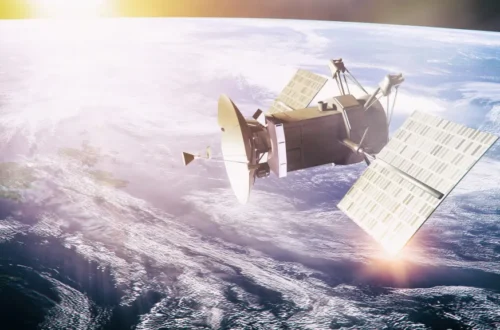
Satellites are the backbone of the space economy. They enable telecommunications, internet connectivity, Earth observation, GPS navigation, and climate monitoring.
Startups such as Planet Labs, OneWeb, and ICEYE are leading the way with miniaturized satellites that can be launched in large constellations at relatively low cost. Companies like SpaceX’s Starlink and Amazon’s Project Kuiper are deploying thousands of satellites to provide global broadband coverage, especially in underserved regions.
The demand for real-time data and connectivity is expected to make the satellite sector worth over $400 billion by 2035, attracting both institutional investors and venture capital funds.
2. Launch Services and Rocket Technology
Developing cheaper, reusable launch systems has been one of the most transformative innovations in space commerce. SpaceX’s Falcon 9 and Falcon Heavy rockets have reduced launch costs by up to 70%, making space more accessible to startups, universities, and smaller nations.
Emerging companies like Rocket Lab, Relativity Space, and Firefly Aerospace are competing in the small satellite launch market with innovative technologies like 3D-printed rockets and autonomous manufacturing.
Investors see immense potential in this sector, as the demand for launching satellites, experiments, and future space infrastructure continues to rise.
3. Space Tourism and Human Spaceflight
Space tourism represents the glamorous and visible face of the space economy. Companies such as Virgin Galactic, Blue Origin, and SpaceX have already conducted successful missions carrying private citizens to suborbital and orbital altitudes.
While still expensive — ranging from $200,000 to $55 million per passenger — space tourism is expected to expand dramatically over the next two decades. Long-term opportunities include space hotels, lunar tourism, and even Mars expeditions.
Investors interested in this sector are drawn not only by financial returns but by the cultural and technological impact of enabling human expansion beyond Earth.
4. Space Infrastructure and Manufacturing
Beyond launches and tourism, a new wave of startups is focusing on building the physical infrastructure of space — including orbital stations, fuel depots, solar power satellites, and in-space manufacturing.
Companies like Axiom Space plan to construct the first commercial space station, while Made In Space (now part of Redwire) develops technologies for 3D printing tools and components in microgravity. These advancements will reduce the cost and risk of long-term missions while enabling the construction of spacecraft and habitats directly in orbit.
This sector has huge investment potential, as it forms the backbone of a sustainable interplanetary economy.
5. Space Mining and Resource Utilization
Asteroids and lunar surfaces contain vast quantities of valuable minerals — including platinum, nickel, and water ice — that can be used for fuel production and manufacturing in space. Startups like Asteroid Mining Corporation, OffWorld, and TransAstra are developing robotic mining technologies to access these resources.
Although still in the early stages, space mining represents a high-risk, high-reward opportunity. Analysts predict that space resource extraction could become a trillion-dollar industry by the late 21st century, once legal and logistical barriers are resolved.
The Investment Landscape
1. Venture Capital and Private Equity
Venture capital has become the main engine behind space innovation. According to Space Capital’s 2024 report, over $300 billion has been invested in space-related companies since 2012. Leading investors include firms like Andreessen Horowitz, Lux Capital, and Founders Fund.
These investors typically focus on early-stage startups, betting on disruptive technologies that can reduce costs or open new markets. The “NewSpace” ecosystem thrives on the belief that private innovation can outperform traditional government projects in both efficiency and scalability.
2. Government Contracts and Public-Private Partnerships
Many startups rely on government contracts to fund operations. Agencies like NASA, the European Space Agency (ESA), and Space Development Agency (SDA) increasingly collaborate with private firms for research, transportation, and technology development.
For example, NASA’s Commercial Crew and Commercial Resupply Services programs have awarded multi-billion-dollar contracts to SpaceX and Northrop Grumman. Such partnerships provide financial stability and credibility to young companies, attracting further private investment.
3. Global Investment and Emerging Markets
The commercialization of space is not limited to the U.S. Countries like India, China, Japan, and the UAE are nurturing private space ecosystems with government support. Indian startup Skyroot Aerospace, for instance, launched the country’s first private rocket in 2022, backed by domestic and international investors.
As global competition intensifies, cross-border collaborations and joint ventures are expected to accelerate investment growth.
Risks and Challenges in Space Investment
Investing in space startups offers exciting potential but also involves significant challenges:
High Capital Requirements and Long Return Cycles
Building rockets, satellites, and spacecraft demands massive upfront investment, and returns may take years to materialize. Unlike software startups, space ventures require physical infrastructure and long testing phases.
Technical and Operational Risk
Space is a hostile environment. Launch failures, system malfunctions, or radiation damage can lead to catastrophic losses. Even successful missions can face unexpected delays and cost overruns.
Legal and Regulatory Uncertainty
International laws governing space property rights, mining, and liability remain ambiguous. The lack of a clear regulatory framework can deter investors or complicate long-term business models.
Market Saturation and Competition
As more players enter the market, competition in satellite and launch sectors is intensifying. Startups must differentiate themselves through innovation and efficiency to survive.
The Future of Space Investment
Despite these challenges, the outlook for space investment is exceptionally bright. Analysts predict rapid growth across all major sectors, driven by decreasing launch costs, rising data demand, and technological breakthroughs.
Future investment opportunities may include:
- Lunar bases serving as fuel depots and research centers.
- Interplanetary cargo networks linking Earth, the Moon, and Mars.
- AI-managed satellite systems for real-time analytics.
- Microgravity manufacturing hubs producing materials for Earth industries.
Furthermore, new financing models such as space-focused ETFs, crowdfunding platforms, and tokenized investment schemes are democratizing access to space capital markets.
Conclusion.
Investing in space startups and private ventures represents one of the most exciting and transformative opportunities of our time. What began as government-led exploration has evolved into a vibrant ecosystem of entrepreneurs, engineers, and investors working to commercialize the final frontier.
Space startups are not merely businesses; they are the architects of humanity’s future — designing the systems, habitats, and technologies that will carry civilization beyond Earth.
For investors, the rewards are not only financial but historical. Supporting space ventures means participating in the birth of a multiplanetary economy, one that will define the next century of progress, innovation, and discovery.