Introduction.
For much of human history, space exploration was a domain reserved for superpower governments and scientific missions. The Space Race of the 20th century was driven by political rivalry and national pride, not profit. But the 21st century has marked a dramatic shift — from a government-led enterprise to a commercially driven space economy.
This transformation, often called the “New Space Age,” is reshaping global industries, investment strategies, and even humanity’s vision for the future.
Rise of Private Space Enterprises
The commercialization of space began gaining traction in the early 2000s, led by pioneering companies such as SpaceX, Blue Origin, and Virgin Galactic. Elon Musk’s SpaceX achieved what was once thought impossible — developing reusable rockets that drastically reduced launch costs. Jeff Bezos’s Blue Origin focused on reusable technology and human spaceflight, while Richard Branson’s Virgin Galactic targeted space tourism.
These companies demonstrated that space is not just a scientific endeavor, but a viable business opportunity. The private sector began investing billions into new technologies, spurred by the promise of satellite launches, lunar missions, and space-based communications.
Key Milestones:
- 2008: SpaceX becomes the first private company to deliver cargo to the International Space Station (ISS).
- 2015: Blue Origin’s New Shepard rocket achieves a vertical landing and reusability milestone.
- 2020: SpaceX successfully launches astronauts to the ISS under NASA’s Commercial Crew Program.
- 2021: The first commercial suborbital flights carry civilians beyond Earth’s atmosphere.
Space is Becoming a Business
The commercial interest in space is fueled by several key factors:
Falling Costs of Launches
Traditionally, sending 1 kilogram to orbit cost around $20,000. With reusable rockets and technological innovation, SpaceX has lowered it to under $2,000 per kilogram — a tenfold reduction. This cost efficiency makes it financially feasible for small startups and even universities to launch satellites.
Growing Demand for Data and Connectivity
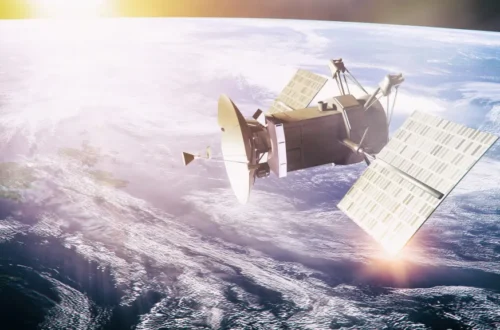
Satellites have become the backbone of modern communication, GPS navigation, weather forecasting, and global internet networks. Companies like Starlink (SpaceX) and OneWeb are deploying thousands of satellites to provide high-speed internet worldwide, especially in underserved regions.
Government Support and Partnerships
Agencies like NASA and the European Space Agency (ESA) are shifting from direct operation to public–private partnerships. By outsourcing logistics and transport to private firms, governments encourage innovation while focusing on scientific research.
New Markets Emerging.
From space tourism to asteroid mining, and from space manufacturing to lunar infrastructure, entirely new industries are forming. Each presents a vast untapped potential for profit and progress.
Major Sectors in the Space Economy.
The global space economy, valued at over $500 billion in 2024, is expected to surpass $1 trillion by 2040. Here are its main commercial sectors:
Satellite Industry.
The largest and most mature segment of the space economy. It includes communication, imaging, weather, and navigation satellites. Private firms now dominate this space, offering data-driven services to agriculture, defense, finance, and logistics industries.
Launch Services.
Companies like SpaceX, Rocket Lab, and Arianespace compete to deliver payloads into orbit at lower costs. Reusable rocket technology has turned launches into a sustainable and recurring service business.
Space Tourism
Virgin Galactic and Blue Origin have made suborbital flights accessible to private individuals. Although still expensive (tickets costing between $250,000 and $500,000), the industry is expected to grow rapidly as costs fall.
Asteroid and Lunar Mining.
This futuristic industry envisions extracting rare minerals and water from asteroids or the Moon. Resources like platinum-group metals and helium-3 could power future economies and energy systems.
Space Infrastructure and Manufacturing.
Companies are exploring orbital construction, 3D printing in space, and space-based solar power. These innovations could enable permanent space habitats and large-scale energy production outside Earth’s atmosphere.
Economic and Strategic Implications
The commercialization of space is not just about technology; it’s about power, economics, and global influence. Countries that foster strong private space sectors will hold significant strategic advantages.
Economic Growth
Space commercialization creates high-value jobs in engineering, data analysis, AI, and advanced manufacturing. It stimulates related sectors — from cybersecurity to telecommunications.
National Security.
Satellites are vital for defense, surveillance, and communication. Countries like the U.S., China, and India view space commercialization as a means to enhance both economic resilience and strategic autonomy.
International Collaboration.
Private companies often operate across borders, fostering global partnerships. For instance, the Artemis Program involves NASA and commercial partners working with countries from Europe to Japan.
Challenges in Commercializing Space
Despite its promise, the commercialization of space faces complex challenges:
Regulation and Space Law
Current laws, like the Outer Space Treaty of 1967, were written for governments, not corporations. Questions about ownership, liability, and the exploitation of extraterrestrial resources remain unresolved.
High Initial Investment.
Developing space technology still requires enormous capital and long-term commitment. Many startups fail before reaching orbit due to funding or technical setbacks.
Space Debris and Sustainability.
Thousands of defunct satellites and fragments orbit Earth, posing collision risks. Without international coordination, space could become dangerously congested.
Ethical and Environmental Concerns.
Mining asteroids, building lunar bases, or colonizing other planets raises ethical questions about humanity’s responsibility beyond Earth. Ensuring that space activities are sustainable and inclusive is a major concern.
Future of the Space Economy.
The future of commercial space is dynamic and multi-faceted. By the 2030s, experts predict:
- Regular cargo and crew missions to lunar bases.
- Growth of space hotels for tourists.
- Commercial missions to Mars for research and resource exploration.
- Expansion of space-based energy and manufacturing industries.
In addition, advancements in AI, robotics, and autonomous navigation will accelerate these developments, making space exploration safer and more efficient.
Conclusion.
The commercialization of space represents a profound shift in human civilization — from exploration for discovery to exploration for enterprise. What began as a government endeavor driven by competition is now a global economic revolution driven by innovation and collaboration.
As the barriers to entry fall and new technologies emerge, the line between “space” and “business” continues to blur. The companies that pioneer this frontier are not just expanding markets; they are reshaping humanity’s destiny among the stars.